
Finding the right breastfeeding position can make a significant difference in your breastfeeding experience. The right position can help ensure a good latch, improve milk transfer, and reduce discomfort for both you and your baby. Here are five common breastfeeding positions, along with instructions and tips to help you get started.
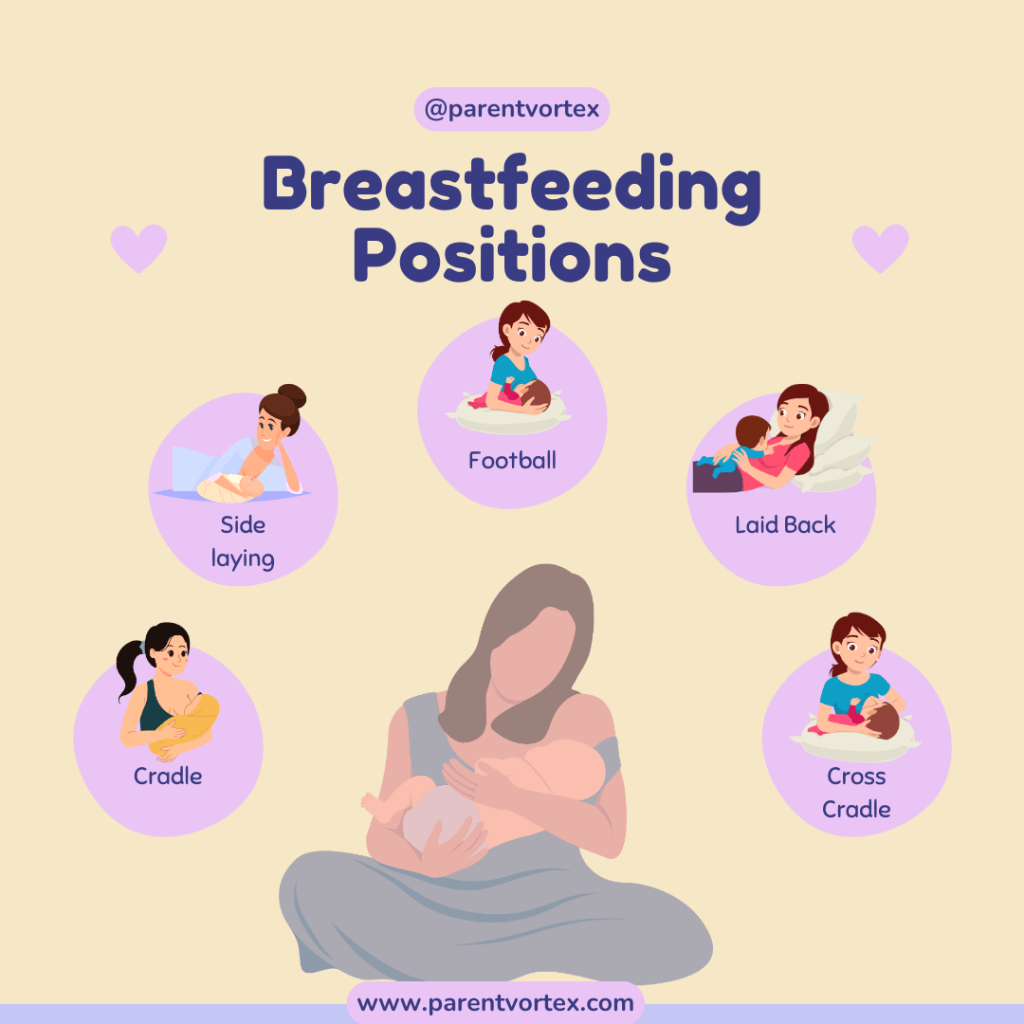
1. Cradle Hold
Description: The cradle hold is a classic breastfeeding position where the baby’s head rests in the crook of the mother’s arm.
How to Get Into the Position:
- Sit in a comfortable chair with armrests or on a bed with pillows for support.
- Hold your baby with their head resting in the crook of your arm, their tummy against your tummy.
- Support their back and bottom with your forearm and hand.
- Use your other hand to support your breast and guide it into your baby’s mouth.
Tips:
- Ensure your baby’s head and body are in a straight line to avoid strain.
- Use a pillow to support your arm and baby, if needed.
- This position works well for older babies who can latch easily.
Example: A mom with a newborn might find the cradle hold a bit challenging initially, but as the baby grows and gains better head control, this position can become more comfortable.
2. Cross-Cradle Hold
Description: Similar to the cradle hold, but the baby is supported with the opposite arm.
How to Get Into the Position:
- Sit comfortably with good back support.
- Hold your baby across your lap, with their head supported by the hand opposite to the breast you are feeding from.
- Use your other hand to support your breast and guide it into your baby’s mouth.
Tips:
- This position provides more control over your baby’s head, making it easier to achieve a good latch.
- It’s particularly useful for newborns and smaller babies.
- Use pillows to support your arms and back.
Example: A new mom struggling with latch issues might find the cross-cradle hold helpful because it offers better control over the baby’s head.
3. Football Hold (Clutch Hold)
Description: The baby is tucked under your arm like a football, with their legs extending behind you.
How to Get Into the Position:
- Sit comfortably with a pillow at your side for support.
- Tuck your baby under your arm on the side you are feeding from, with their legs extending towards your back.
- Support your baby’s neck and head with your hand, guiding their mouth to your breast.
- Use your other hand to support your breast if needed.
- Use a pillow to prop your baby up closer to you. Tuck it under their bum to bring their mouth to your nipple instead of your nipple to their mouth. Always bring baby closer to you vs. bringing your breast to them.
Tips:
- This position is excellent for mothers who have had a C-section, as it keeps the baby away from the incision site.
- It’s also beneficial for moms with large breasts or those nursing twins.
- Ensure your baby’s head is at the level of your breast to avoid straining your back or shoulders.
Example: A mom who has had a C-section may prefer the football hold to avoid pressure on her abdomen.
4. Side-Lying Position
Description: Both mother and baby lie on their sides facing each other.
How to Get Into the Position:
- Lie on your side with a pillow supporting your head.
- Place your baby on their side, facing you, with their mouth level with your nipple.
- Use your arm to support your baby’s back and head, or use a rolled-up towel or small pillow for support.
- Guide your baby’s mouth to your breast.
Tips:
- This position is great for night feedings or for moms recovering from childbirth.
- Ensure your baby’s nose is clear for easy breathing.
- Make sure your baby’s whole body is facing you to avoid any twist in their neck or back.
Example: A mom who prefers to breastfeed while lying down, especially during night feedings, might find the side-lying position very convenient and restful.
5. Laid-Back (Biological Nurturing) Position
Description: The mother reclines comfortably, and the baby lies on top of her, tummy to tummy.
How to Get Into the Position:
- Recline in a comfortable chair or bed, supported by pillows.
- Place your baby on your chest, tummy down, with their head near your breast.
- Let your baby use their natural instincts to find your nipple and latch on.
- Support your baby’s head and body as needed.
Tips:
- This position uses gravity to help the baby latch naturally.
- It’s very relaxing and allows for skin-to-skin contact.
- Ensure your baby’s nose is clear for breathing.
Example: A mom wanting to encourage her baby’s natural breastfeeding instincts might choose the laid-back position, especially in the early days when the baby is learning to latch.
Final Thoughts
Finding the right breastfeeding position is a personal journey and can vary from one feeding session to another. It’s essential to experiment with different positions to discover what works best for you and your baby. Remember, comfort is key, and a good latch is crucial for a successful breastfeeding experience.
At Parent Vortex, we’re committed to supporting you on your breastfeeding journey. Join our community for more tips, encouragement, and shared experiences as we navigate the wonderful world of parenting together. For more detailed strategies, don’t forget to check out our posts on Unlocking the Secrets of Successful Breastfeeding, Overcoming Common Breastfeeding Challenges.
Question: What is your favorite breastfeeding position, and why? Share your experiences and tips in the comments below!
 PARENT VORTEX
Leave a comment